
Do you tell Chat everything?
How to stay protected in the AI Age.
By: Ryan Ancona | AI Chat Safety | Proton | 10/2/2026
This post contains affiliate links. If you sign up through them, Creed8 may earn a commission at no extra cost to you.
You’ve heard the joke, “When I die, don’t look at my internet history.” It was a funny nod to the weird, personal and hopefully not illegal searches you made on Google, thinking it was just a private conversation between you and your phone. Now I’d bet more people would much rather their internet history get leaked than their private messages to ChatGPT. This is the AI age. Beyond the fact that AI has found itself in almost every aspect of our digital world, learning off our digital footprint, our online patterns and, yes, way too often our intellectual property, especially our art, the way AI learns the most from us is from what we tell it ourselves. The personal connection between a chatbot and a person can feel like you’re having a private conversation specifically tailored to you and your needs. Whether it’s talking really personal details about your love life or a weird mole on your toe, or your banking details and entire business secrets, it’s important we stay educated and learn to adapt with the changes in our technology so that we keep ourselves protected and secure.
What the Proton AI chatbot privacy survey found.
(Note from Proton: This survey included 4,014 respondents across France, Germany, the UK, and the US. All respondents were screened to confirm they currently use an AI chatbot or assistant. The survey was administered online and consisted of approximately 12 questions on AI chatbot usage. Respondents were not told which company commissioned the research. This unbranded design was intended to reduce the influence shaped by any company’s reputation.) See original survey here
Proton, one of Creed8’s partners for office workspace tools, VPN and their own privacy-first AI, Lumo, recently did a survey on how much people trust AI, and the results weren’t surprising. We clearly don’t.
| Stat | Finding |
|---|---|
| 66% | Around 66% of people using AI tools admit to opening up about deeply personal matters, ranging from private finances to relationship issues and personal health. |
| 42% | About 42% don't really trust tech companies to keep their private conversations secure. |
| Financial worries, mental health struggles, and job stresses top the list of things we share with bots. | |
| Even so, most of us still prefer confiding in real loved ones over chatbots or professional therapists. | |
| The main reason we talk to AI instead of humans comes down to pure convenience and zero judgment. | |
| 44% | Nearly half (44%) would feel far more comfortable sharing if they knew their data wouldn't train future models. |
| 70%+ | Over 70% are interested in an assistant built entirely with privacy in mind from day one. |
Source: Proton AI chatbot survey, 4,014 chatbot users across the US, UK, France and Germany.
66%, in my personal opinion, sounds kinda like a lowball, as I know personally in my friend groups and life I’ve heard people using chatbots for just about anything, to the point it’s become a joke that people are having full-blown relationship conversations between their respective chatbots, and it’s just two bots talking to each other. If you’ve ever seen the show Silicon Valley, it reminds me of the scene where Gilfoyle creates an AI bot to get out of talking to his coworkers.
If you have seen that show, you also know how AI can go really bad. The survey was done over 4 countries: America, France, Germany and the UK, with America ranking the highest in disclosing sensitive information at 68.4%, and France being the lowest at 60.3%.
So what is being shared? The big three: money, mental health and work, with money of course being the most discussed topic overall. The top topic varied by country: mental health for Germany, career problems for the US, and personal finances for both France and the UK.
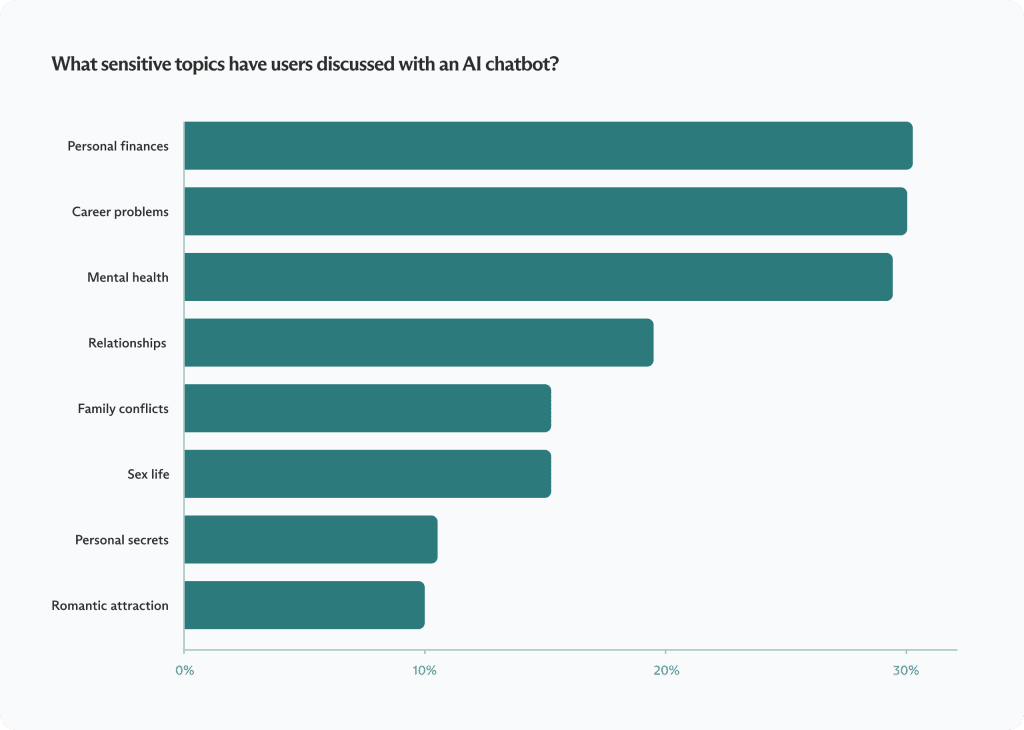
Source: Proton, “People don’t trust AI, but they tell it everything”. Survey of 4,014 AI chatbot users across the US, UK, France and Germany. Chart recolored by Creed8.
Luckily even with this data at the end of the day most people still said they would prefer to go to friends and family for sensitive topics. At the end of the day nothing is more secure than putting down the device and going to a trusted person and in the case of business a professional who will keep your information secure and private. As technology grows its a more important time than ever to use your time to connect with those you care about and build systems that dont rely on technology at all. Of course people are busy, sometimes we don’t have access to those people or a number of real scenarios that may mean we don’t have a safe or convenient way to get the advice or support we need. The study actually shows that convenience and freedom from judgment are the main reasons people are going towards AI. All four countries agreed that convenience was the main reason they went to a chatbot for career and work advice. Personally as someone that hasnt always had access to unlimited resources and a strong network of people in my field ive learnt a lot of my knowledge through the internet and now with the AI age the possibilities for accessibility and knowledge sharing to a much wider audience is now possible. We talk a lot about what AI steals but we also can look at what we can learn from a shared body of knowledge being able to give educational advice, systems and help to areas and people that once lacked the resources.
That is of course if we are being responsible with our data, we are educated to use it to expand our own lives and knowledge rather than another tool to be abused by power hungry tech corporations and an excuse to not think for ourselves.
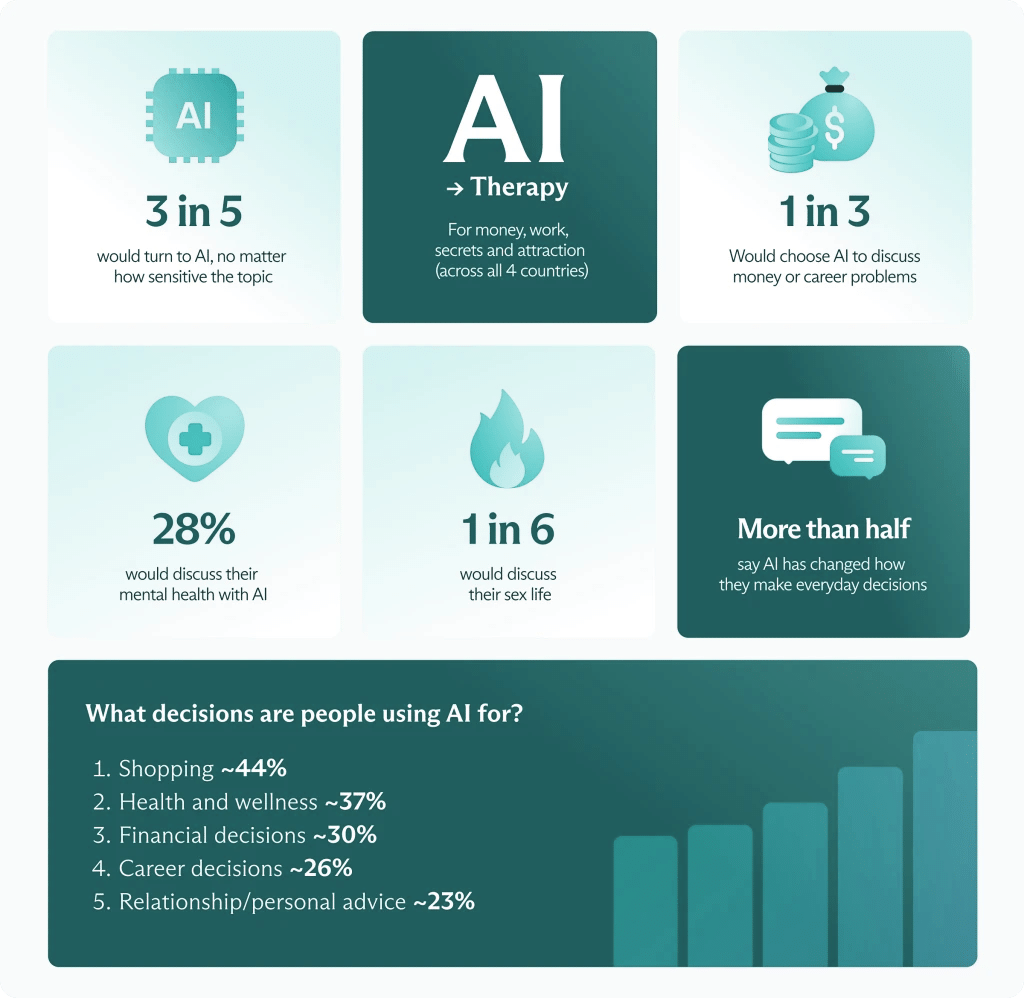
Source: Proton, “People don’t trust AI, but they tell it everything”. Survey of 4,014 AI chatbot users across the US, UK, France and Germany. Chart recolored by Creed8.
The study found that France ranked the highest on their lack of trust in AI at 47.7%, with 41.6% in the UK, 40.5% in Germany, and 38.8% in the US, with only 11% to 20% of respondents having a high level of trust with their private information. This is good and shows that there is a large amount of people who are rightfully distrusting of these new technologies. The biggest concern was less that our personal information was sitting in an unknown data center somewhere to train their own models and more that the same information was being used to profile us for advertisers. A guarantee that conversations wouldn’t be used to train AI models would make 44% of respondents more likely to share sensitive information. Over 70% of people were interested in an AI chatbot that was designed around privacy first. This, of course, is where they (and, well, I as well, since Creed8 is a Proton partner) talk about Lumo (my link).
Proton’s solution Lumo
Lumo is Proton’s own privacy-first AI assistant. On top of Proton’s already stacked list of privacy business software, like their VPN and their Proton Mail, Drive and other office software that competes directly with Google Workspace and Microsoft 365 while not selling your data to who knows what, Lumo AI is a fully encrypted chatbot. Even Proton themselves can’t access or see what you’re sending. They promise to never sell your data or use it for AI training, your chats aren’t logged, there are no ads, they’re based out of a high-privacy jurisdiction, and their code is open source and can be reviewed by anyone, so developers can confirm that there’s no funny business in that promise. They themselves make the bold claim that they have the best AI assistant for privacy out there. You can sign up using my link here, or try it for free and see what you think for yourself without even having to make an account.
Creed8 and Proton
At Creed8 we are a tech studio first, so we really can’t get around bringing AI into the conversation. As a coder who loves the tedious parts and a PowerShell automator, trust me, I’ve tried to avoid it as long as I could. That said, AI solutions are only a part of what Creed8 supports and builds on. We specifically push “practical AI” use, not following trends or unnecessary implementation, while also advocating for more environmentally safe advancements and very specifically security-safe uses. That’s why Creed8 partnering with Proton is such a great fit for our philosophy. They are a Europe-based company all about privacy and freedom. They provide an alternative to the big names, Google and Microsoft, for your business office software, with a full suite of tools such as Mail, Drive, VPN, Password Manager and more. See here for our Creed8 links if you’re interested in their services and want to support Creed8 (we get a small comission from sign-ups using our links), or email or call us here to have us set up their services for you, or if you want to migrate to a more secure business mail or office workspace.
Some tips on being safer while using a chatbot
Turn off training
By default, the big AI companies can use your chats to train their next model. There's a setting to stop it in every major chatbot. Find it, switch it off, and that's two minutes well spent.
Run the stranger test
Before you paste something in, ask yourself one question: would I email this to a total stranger? If the answer is no, it doesn't go in the chat either.
Strip out the details
Names, emails, addresses, account numbers. "My friend" gets you the exact same advice as her full name and street address. The AI doesn't need the specifics to help you.
Never share logins
Passwords, two-factor codes, recovery keys, bank details. No chatbot needs these for anything. If one ever asks, that's your sign to close the tab.
Turn off memory and unplug what you don't use
Memory lets the AI build a running file on you across every chat. And every app you've connected, your email, your drive, your calendar, is another door into your life. Keep only what you actually use.
Check your ad settings
ChatGPT shows ads now. If personalized ads are on, your past chats and memory can shape what you see. That's a setting, and you can turn it off.
Lock the account itself
Turn on two-factor login, and sign out on any device you share. All the privacy settings in the world don't matter if someone else can just open your account.
Use a private AI for the personal stuff
Some conversations just shouldn't go through a company that runs on data. In the context of this blog, use Lumo by Proton. It keeps no logs of your chats, doesn't train on them, and doesn't use them to profile you. In a future blog we will go over running a local chatbot for maximum privacy.
Get the free one-page guide
All 8 tips on one page. Print it, save it, or send it to the person in your life who tells Chat everything.
So how do i use AI safely?
To be honest with you, there is no 100% safe way to be on the internet, in the same way there’s no 100% safe way to go for a drive in a car. We can, however, take all the necessary precautions and learn to keep our data safe from now on. We can’t predict what’s the next major cyber leak, or if the horror stories about the next AI model by Anthropic are true and it really is the human killer they want us to believe it is, for some reason. Being proactive is truly the best thing, and when you’re Creating With Creed8, we’re constantly learning and protecting your data from these new threats. We work with creative-led businesses so that you can focus on your craft while we handle the tech, and one of the ways we do that is applying the latest precautions and security measures to keep that craft protected from being used as AI training tools or being scraped by mass farms. AI is a tool that is growing, but we believe when it comes to creativity and your privacy, that should be something only you are in charge of. Interested in our services, whether a Targeted Fix or one of our Tech Partner or Architect plans? Book a free tech assessment today and let’s see how we can connect and bring your tech systems together.
Want to learn more on the latest tech, internet safety and AI news, tutorials and opinion pieces? Sign up for our newsletter and video content series, Creed8 Blueprints.
